

Almost every small business owner eventually hits the same fork in the road. You have a website, a modest budget, and a need for customers who do not already know your name. Should you invest in search engine optimization (SEO) and earn rankings over time, or buy your way to the top of the results page with paid search ads?
The honest answer is that these two channels are not really competitors. They solve different problems on different timelines. The mistake is treating the choice as permanent. Most small businesses that succeed online do not pick one forever. They start with one, learn what their customers actually search for, and layer in the other. The real question is which one to start with, and that depends on your situation rather than on which channel is “better.”
The core trade-off: speed versus compounding
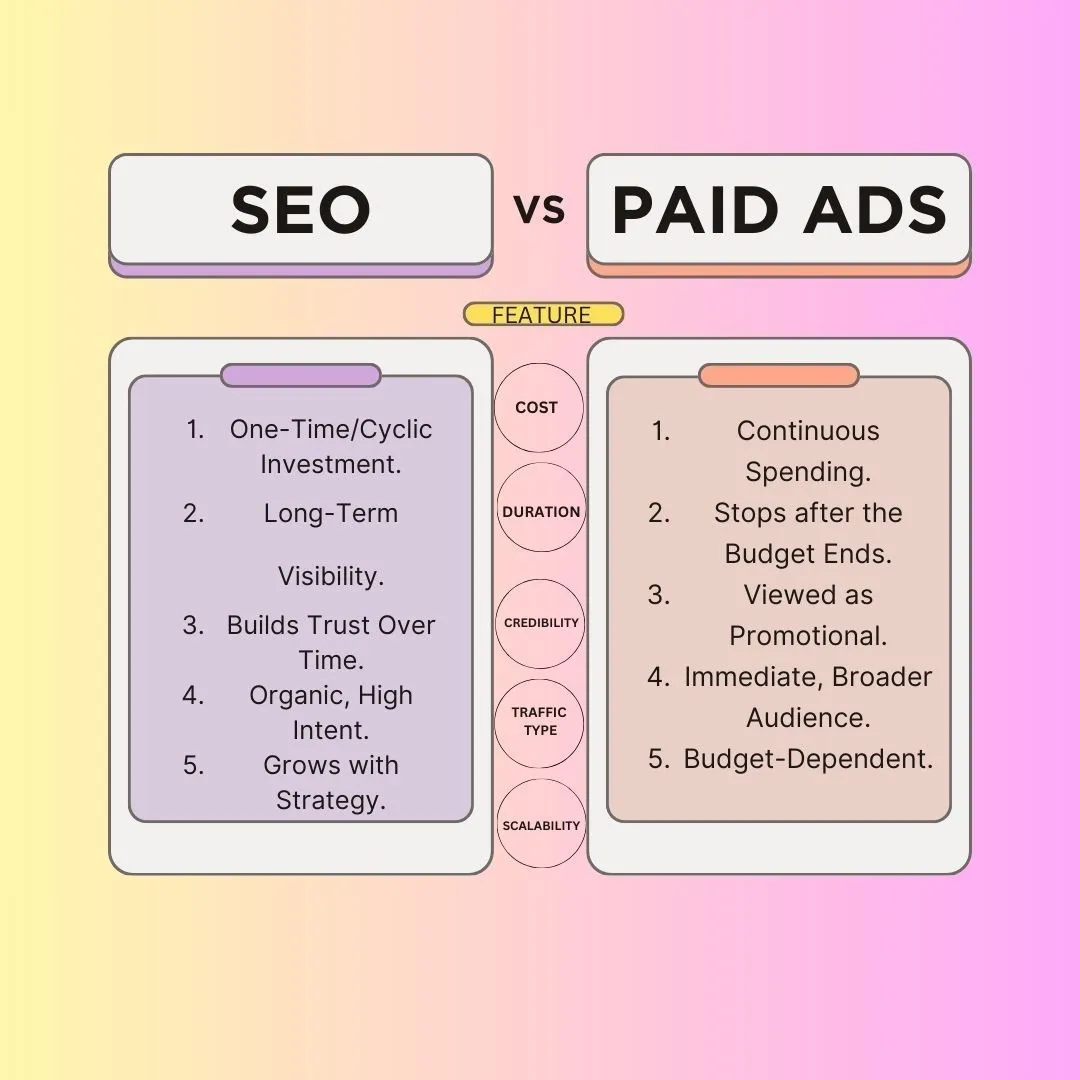
Paid ads are fast. You can launch a Google Ads campaign this afternoon and have qualified visitors on your site by dinner. The moment your card is charged, you have traffic. The moment you stop paying, that traffic disappears. Paid search is a faucet: it runs while the money flows and shuts off when it stops.
SEO is slow and cumulative. You publish useful pages, earn links and trust, and rankings climb over weeks and months. The payoff is that the asset keeps working after you stop actively investing in it. A page that ranks well can bring in visitors for years at no additional cost per click. SEO is less like a faucet and more like planting a tree: nothing happens for a while, and then it produces shade every season.
That single distinction (rented traffic versus owned traffic) drives most of the decision.
What each channel actually costs
Paid search has gotten more expensive. According to WordStream’s 2025 Google Ads benchmarks, which analyzed campaign data from April 2024 through March 2025, the average cost per click across all industries was $5.26, and search ad costs have risen for five straight years (WordStream). Competitive categories cost far more. The same report put the average click in attorneys and legal services at $8.58 and in home and home improvement at $7.85. For a plumber or a personal injury lawyer, a single click can cost the price of a sandwich, and not every click becomes a customer.
SEO has no per-click fee, but it is not free. You pay in time, content, technical work, and patience, and the results are not guaranteed on a fixed date. The cost structure is roughly the inverse of paid: high effort up front, low marginal cost later. Building organic visibility through DGR TechLabs or any disciplined in-house effort is an investment in an asset rather than a recurring rental payment.
Intent: who is actually searching
Both channels intercept people at the moment they are looking, which is what makes search marketing so valuable in the first place. The difference is subtler. Paid ads let you target high-intent commercial queries precisely, including phrases like “emergency roof repair near me,” and you only show up when you choose to bid. SEO tends to capture a wider funnel: the quick how-to question, the comparison research, the “best X for Y” search that happens long before someone is ready to buy.
There is a newer wrinkle worth understanding. AI-generated summaries are changing how often people click any result at all. A Pew Research Center study published in July 2025, based on the real browsing activity of 900 U.S. adults across nearly 69,000 searches in March 2025, found that users clicked a traditional search result on 8% of visits to pages that showed an AI summary, compared with 15% of visits to pages without one (Pew Research Center). That pressure on organic clicks is one reason a balanced approach matters more than ever: relying on a single channel leaves you exposed when the results page shifts under your feet.
A “start here if” framework
Rather than debating which channel wins in the abstract, match the channel to your circumstances.
Start with paid ads if:
- You need customers this month, not next quarter. A new location, a seasonal push, or a cash-flow gap calls for the faucet.
- You are testing a new offer or market and want fast data on what messages and keywords convert.
- Your margins per sale are high enough to absorb a $5-plus click and still profit.
- Your website is brand new and has little chance of ranking organically yet.
Start with SEO if:
- You can wait a few months for results and want traffic that does not vanish when spending stops.
- Your customers research before they buy, asking questions and comparing options.
- Paid clicks in your industry are expensive enough to erode your margins.
- You are building a brand and a body of content you will own for years.
Do both, in sequence, if you are like most small businesses. The practical pattern is to use paid ads to generate immediate revenue and, just as importantly, to learn which keywords and landing pages actually convert. Then feed those proven, high-intent terms into an SEO strategy so you gradually earn the same traffic for free and reduce your dependence on the ad auction over time.
The bottom line
SEO and paid search are tools, not tribes. Paid ads buy you speed and certainty at a recurring cost. SEO buys you a durable asset at the price of time and patience. The businesses that struggle are usually the ones that treat the decision as final, pouring everything into one channel and ignoring the other.
Start with the channel that fits your timeline, your margins, and how your customers search. Then let real performance data, not opinion, decide when to add the second. In a results landscape where even getting a click is no longer guaranteed, having both levers to pull is not a luxury. It is how small businesses stay resilient.
